

Free-space optical communication (FSO) is a technology that transmits data through light traveling in free space, such as air, vacuum, or outer space, without using physical cables. Instead of relying on fiber optics, FSO systems use lasers to send information between two points in a wireless optical link.
Laser Communications
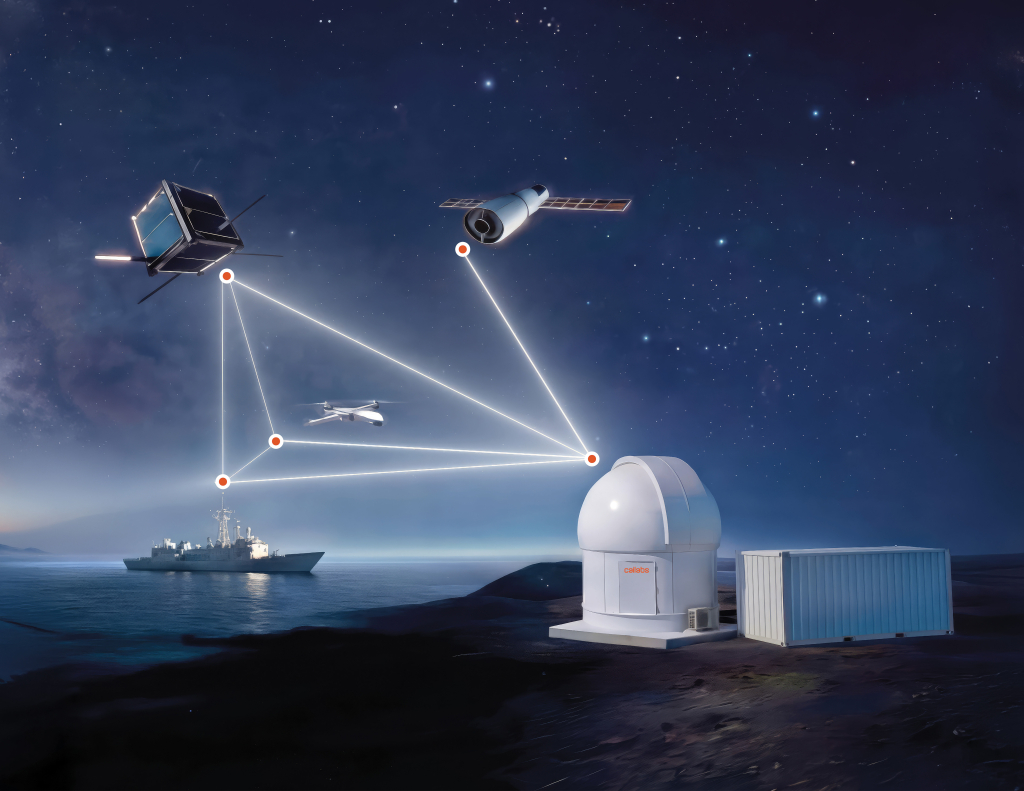
Optical communications are a cornerstone of future space and terrestrial connectivity infrastructures. Combining ultra-high data rates, Low Probability of Intercept (LPI), Low Probability of Detection (LPD), and freedom from spectrum licensing constraints, they enable secure, high-capacity, and resilient communications even in contested, denied, or jammed environments. As demand continues to grow across commercial, institutional, and defense sectors, Cailabs’ proprietary optical technologies enhance the robustness and reliability of laser communication systems, helping accelerate their adoption at scale.

Our Offers
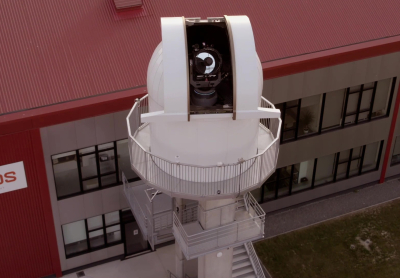
Optical Ground Stations
Deploy space-to-ground optical communication networks achieving speeds of over 10 Gbps with TILBA®-OGS optical ground stations, combining our advanced turbulence mitigation technology with our expertise in photonic component integration.
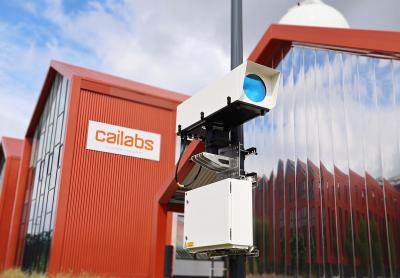
Line Of Sight
Establish 10+Gbps point-to-point optical links exceeding 10 km with TILBA®-LOS for land, air and sea communication networks, combining our advanced turbulence mitigation technology with our expertise in photonic component integration.

Technology Building Blocks
Enhance the reliability of free-space optical communications with our cutting-edge TILBA® technology building blocks, providing effective atmospheric turbulence mitigation and increased laser power during transmission.
FAQ
All TILBA® FAQsThe main performance differences between optical and radio frequency (RF) communications stem from their operating frequencies. Optical systems, which use light, offer a much wider bandwidth, enabling data rates up to 100 times faster and significantly lower latency than RF links. They also provide enhanced security and stealth, thanks to the high directionality of the optical beam and are completely immune to electromagnetic interference. However, RF communications remain more robust in adverse weather conditions and not affected by atmospheric turbulence, while being able to operate without a direct line of sight.
Optical communications are inherently resilient to jamming. Their highly directional laser beams significantly reduce the risk of interference, interception, and detection compared to conventional radio-frequency systems. Combined with Low Probability of Intercept (LPI) and Low Probability of Detection (LPD) characteristics, they provide secure, high-capacity connectivity even in contested, denied, and electronically jammed environments.
TILBA® builds on three core building-block technologies, TILBA®-ATMO, TILBA®-IBC, and TILBA®-CBC, all derived from Cailabs’ proprietary Multi-Plane Light Conversion (MPLC) technology.
✓ TILBA®-ATMO provides Rx turbulence mitigation without adaptive optics, using a fully passive and non-mechanical approach.
✓ TILBA®-IBC leverages Incoherent Beam Combining for Tx turbulence mitigation, enhancing transmission robustness under turbulent atmospheric conditions.
✓ TILBA®-CBC leverages Coherent Beam Combining to enhance transmission performance by phase-aligning multiple laser beams into a single, powerful and coherent output.


