

Getting Satellite Images Down Before They Go Stale
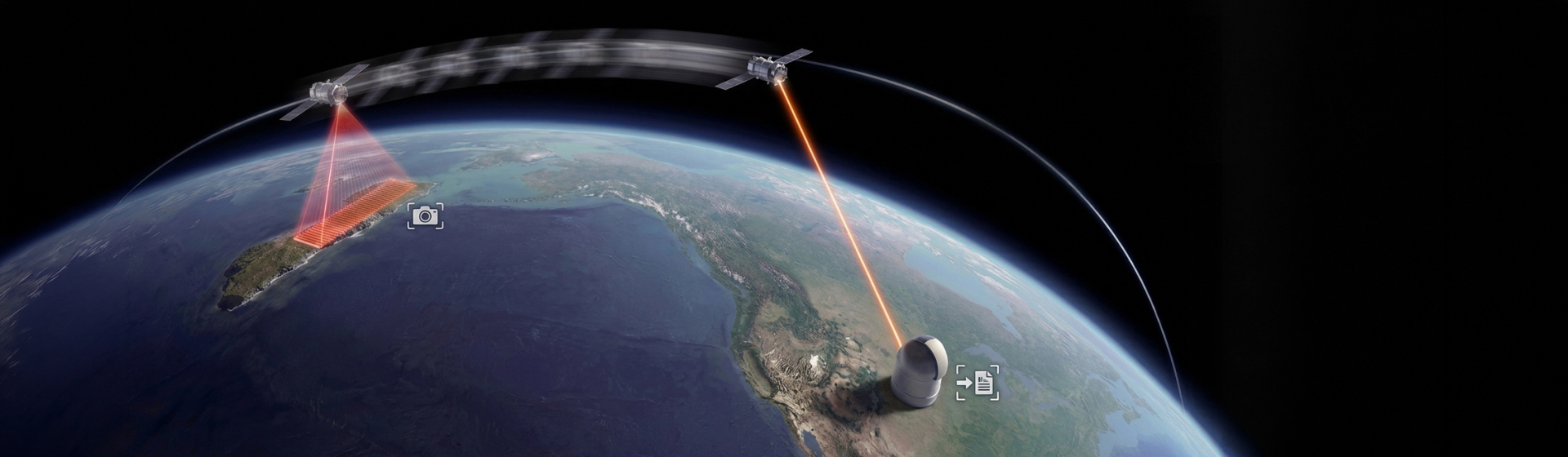
How optical ground networks shorten the path from image acquisition to decision-making
When a satellite captures an image, the clock starts ticking. For Earth observation (EO) operators, the value of data depends on how quickly it can be delivered to users: an image only becomes actionable intelligence once it reaches the ground.
Whether monitoring military activity, maritime traffic, critical infrastructure, natural disasters, or environmental events, every minute matters. Access to actionable intelligence within minutes rather than hours can determine whether an event is observed, understood, and acted upon in time.
However, as Earth observation satellites collect increasingly large volumes of data, reducing the time between image acquisition and data delivery has become a major challenge. While optical communications have largely solved the downlink capacity bottleneck, achieving low-latency Earth observation now depends on a different factor: rapid access to a high-performance optical ground network.
From RF-constrained downlinks to multi-gigabit data delivery
EO satellites are not limited by their sensors, but by their ability to bring data back to Earth. Modern payloads can collect far more data than conventional RF links can transmit during a single pass, forcing operators to rely on multiple downlink opportunities to deliver large datasets. Optical communications have changed the equation. With a 10 Gbps laser communication terminal, an EO satellite can transmit a typical 25 GB synthetic aperture radar (SAR) image (5 × 5 km, 0.5 m resolution) in just 27 seconds, whereas the same dataset would require nearly 11 minutes over a conventional 300 Mbps X-band link.


| X-band | Optical | |
| Contact satellite time | 8 minutes | 6 min 30 sec |
| Mean net useful throughput | 311 Mbps | 7.5 Gbps |
| Total transmitted volume | 18 GB | 365 GB |
Thus, instead of requiring two RF passes to deliver a single SAR image covering 25 km², EO operators can now downlink more than 14 images during a single optical pass, representing over 350 km² of EO intelligence delivered to the ground in just a few minutes.
As a result, time-to-data availability increasingly depends on how quickly a satellite can access an available optical ground station (OGS).
Without relying on space-based data relay, optimizing satellite-to-ground contact opportunities therefore becomes a key driver of time-to-intelligence performance.

Reducing time-to-intelligence requires an optimized optical ground network
Low capture-to-delivery latency requires immediate access to a space-to-ground downlink opportunity after image acquisition. Thus, the location and distribution of OGS become critical design parameters.
Optical communications are affected by cloud coverage, atmospheric turbulence, and aerosols. This creates a fundamental difference between optical and RF network architectures. RF ground networks often favor polar locations, where EO satellites repeatedly converge along the same orbital corridors. In contrast, optical ground networks benefit from a broader geographical distribution to maximize weather diversity and contact opportunities.


10-Optical ground network (left) vs 10-RF ground network (right)
As a result, co-locating OGS along the same orbital plane provides diminishing returns. Instead, distributing ground entry points across multiple regions and orbital planes increases the probability of establishing a downlink opportunity shortly after image acquisition, reducing capture-to-delivery latency across the constellation.
OGSaaS by Cailabs delivers dozens of fresh SAR images within 15 minutes
Consider a constellation of 48 LEO satellites operating in six sun-synchronous orbital planes at an altitude of 550 km with an inclination of 97.7°. Combined with a geographically distributed network of 15-OGS, representative of OGSaaS by Cailabs architecture, operators benefit from increased downlink opportunities, weather diversity, geographic redundancy, and enhanced network resilience.

By strategically distributing optical ground stations across multiple regions and orbital planes, operators gain more downlink opportunities, reduce capture-to-delivery latency, and support high-volume intelligence data delivery without relying on space-based relay systems. The examples below show that dozens of SAR images can typically be delivered within 15 minutes of acquisition, enabling frequent refreshes of strategic areas of interest and accelerating access to actionable intelligence.
| Area of interest | Average daily GB delivered within 15 min | Average number of SAR images delivered within 15 min |
| Eastern Ukraine | 1805 | 72 |
| Suez canal | 2 179 | 87 |
| Teheran | 1052 | 42 |
| Bosphorus Strait | 2 175 | 87 |
| South China Sea | 639 | 25 |
| Hormuz | 1 154 | 46 |
| Panama canal | 581 | 23 |
Conclusion: Delivering actionable intelligence in minutes with optical ground networks
A distributed optical ground network architecture at the scale of OGSaaS by Cailabs delivers dozens of SAR images within 15 minutes of acquisition across several strategic regions of interest. This enables frequent refreshes of large areas of interest, significantly accelerating the transition from image acquisition to actionable intelligence.
This illustrates how access to a global optical ground network enables EO operators to achieve low capture-to-delivery latency.
Looking beyond optical ground networks, even lower latencies can be achieved through space-based optical relay systems, bringing Earth observation closer to persistent, near real-time intelligence delivery.