

How many OGS does a ground network need to reach 99.99% availability?
From RF to Optical Communications
Laser communication (lasercom) offers direct answers to the fundamental challenges faced by radio frequency (RF) satellite communication (satcom) networks today. The growth of satcom traffic is far outpacing the capacity of traditional ground segment infrastructure. At the same time, existing RF ground terminals have been shown to be vulnerable to both physical threats and regulatory pressures. Lasercom guarantees higher throughputs (100+ Gbps), more secure and sovereign communications (LPI/LPD), and is not subject to spectral licensing in any region. As a result, the upcoming constellations developed by commercial New Space companies as well as institutional and sovereign programs are already integrating optical communication capabilities in orbit.
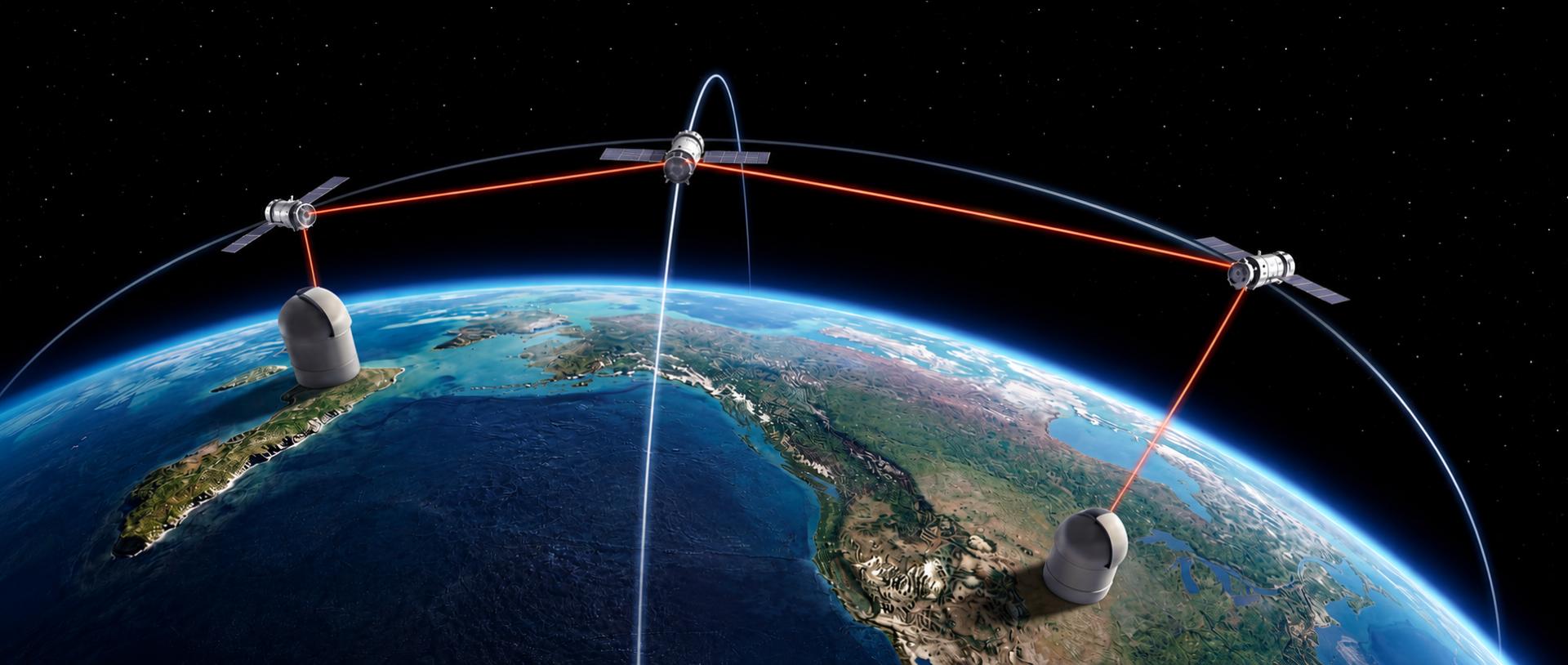
Up until now, optical ground stations (OGS) have been considered as standalone assets and deployed primarily as individual technology demonstrators. Building an operational optical ground network, however, requires a fundamentally different perspective. Optical satcom networks must be designed as a coordinated mesh, leveraging space-based routing enabled by optical inter-satellite links (OISL) to enable reliable space-to-ground (S2G) capacity levels that are orders of magnitude beyond those of today’s RF ground infrastructures. As optical links are more sensitive to atmospheric conditions such as cloud coverage, aerosol attenuation, and atmospheric turbulence, optical ground networks rely on geographically distributed optical ground stations (OGS) to ensure service continuity through site diversity, with OISLs further enhancing routing flexibility when available.
An optical network-minded approach is therefore not to identify the best individual site for demonstration, but rather to design the right combination of locations capable of delivering continuous service availability across a distributed network.
Contrary to common assumptions, achieving 99.99% availability does not require dozens of optical ground stations. Our analysis shows that fewer than ten carefully selected OGS locations can already deliver carrier-grade service availability.
Optical Ground Network Architectures Are Fundamentally Different from RF
The orbital geometry of a satellite constellation directly influences network performance. The geographical distribution of ground stations determines which orbital passes can be used to establish space-to-ground links. For communication constellations, the objective is to maintain continuous connectivity and therefore maximize the availability and utilization of space-to-ground links. RF ground segments often rely on high-latitude stations because polar orbits naturally pass over these regions several times per day. For optical communications, however, these locations are not always ideal.
In contrast to traditional RF links, optical links are strongly dependent on atmospheric conditions. High-latitude regions frequently experience persistent cloud cover, limiting optical availability. Many sites well suited for RF communications are not ideal for optical communications. The comparison between Svalbard and Los Angeles illustrates this challenge in practice.

Rather than concentrating the network near the poles, an optical architecture benefits from multiple mid-latitude stations distributed across different continents.
By leveraging geographic diversity, these locations maintain excellent access to polar-orbiting satellites while significantly improving weather availability.

Beyond cloud cover, aerosol attenuation is another important factor in optical ground network design. Even when skies are clear, atmospheric aerosols such as dust, pollution, sea salt, and smoke can reduce optical signal strength through scattering and absorption. Because these effects are wavelength-dependent and vary significantly between locations, aerosol statistics should be considered alongside cloud availability when assessing OGS performance and selecting network sites.

Conversely, unlike traditional RF infrastructures, optical ground networks benefit from greater deployment flexibility. Optical ground stations do not require exclusive radio spectrum or protection against RF interference. They can therefore be deployed much closer to Internet Exchange Points (IXPs), major data centers, and terrestrial fiber infrastructure. Industrial optical ground stations have already demonstrated reliable low-elevation communications (<20°) at sea level and near urban areas. This reduces terrestrial backhaul costs, simplifies integration into cloud infrastructures, and avoids many of the regulatory constraints traditionally associated with RF gateway deployment. Rather than searching for isolated radio-quiet locations, operators can optimize their networks around connectivity, operational efficiency, and weather diversity simultaneously.
Weather Complementarity Is the Key to High-Availability Lasercom
The performance of an optical ground network depends not only on the availability of each station individually, but also on how their weather conditions are correlated over time. While it might seem straightforward to think that a collection of the most available individual sites would create the most available network, the reality is different.
If two stations are simultaneously covered by clouds, the second station provides redundancy rather than additional visibility. Conversely, two individually less favorable stations experiencing different weather patterns may significantly increase the probability that at least one optical path remains available.

Because cloud cover is local and variable, optical ground segment design is inherently network-centric. The key question is not only “where should we install an OGS?” but “which combination of OGS sites provides the required service level over time?” This shifts the design problem from single-site optimization to network availability engineering.
Expanding the network further can push availability beyond 99.99%, depending on geography, weather correlation, access constraints, and network orchestration. Selecting OGS locations therefore becomes a network optimization problem rather than a site ranking exercise. The objective is not to maximize the availability of each station independently, but to maximize the availability of the network as a whole.
99.99% Availability with Fewer Than 10 OGS
Optical ground networks do not require dozens or hundreds of stations to achieve high service availability. By leveraging geographic diversity and complementary weather conditions across sites, network performance increases rapidly as new stations are added. Optimized OGS networks based on ten years of hourly global cloud data show that network availability increases rapidly with the first few stations before gradually reaching a plateau:
- 2 complementary stations increase availability to ~ 90%
- 4 OGS reach 99%
- 8 OGS exceed 99.99% network availability

Conclusion: Network Design Enables High-Performance Optical Services
While the performance of OGS at optimal demonstrator sites is important for showing new technology, these individual demonstrators are often not representative of operational optical ground infrastructure. A distributed OGS network should be evaluated at the network-level, in terms of capacity, availability, cost, and latency. Weather diversity is an extremely effective lever for improving service availability. The most effective OGS network is therefore not necessarily the collection of sites with the clearest skies, but the combination of stations whose weather patterns are the most complementary.
Careful optimization of geographic diversity allows relatively small optical ground networks to deliver carrier-grade levels of availability. Our analysis shows that network availability increases rapidly with the first stations deployed, enabling availability levels above 99.99% with fewer than ten well-positioned OGS.
The challenge is therefore not to build hundreds of optical ground stations, but to engineer the right network architecture. Success depends less on identifying the “best” individual site than on selecting the combination of locations that maximizes service continuity across the network.