

SDA-Compatible Bidirectional Space-to-Ground Optical Link: Operational Lessons from Real Satellite Passes
What Real SDA-Compatible Satellite Passes Reveal About Optical Ground Station Performance
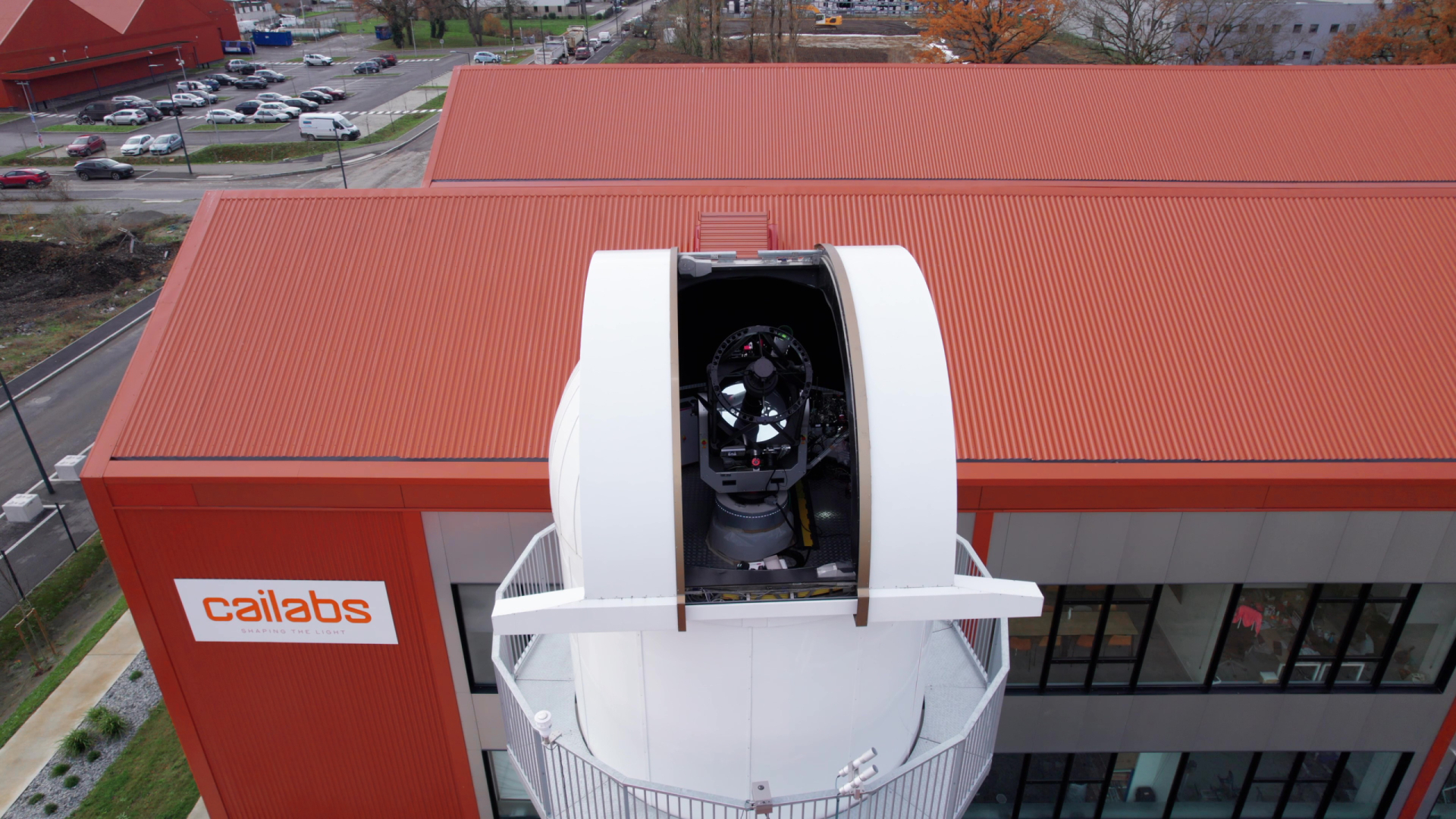
During real LEO satellite passes over Rennes, France, Cailabs’ Optical Ground Station (OGS) established bidirectional optical links with Kepler Communications’ Pathfinder satellites equipped with TESAT SCOT80 terminals. The campaign demonstrated acquisition and tracking, as well as error-free bidirectional data transfer during a large communication window.
Beyond the successful links themselves, the measurements reveal two operational lessons: architecture choices determine operational pass time and acquisition time determines usable communication time.
A bidirectional optical SDA-compatible link, captured during a real LEO satellite pass
This video captures a bidirectional SDA-compatible space-to-ground optical link as it actually happens: it shows the actual sequence of acquisition, tracking and communication seen from the optical ground station during an operational pass of more than eight minutes, accelerated 12x for readability. It is not an animation or a reconstructed representation of the link.
During the pass, Cailabs achieved robust tracking from 12° ascending to below 10° descending elevation, with error-free bidirectional data transfer throughout the main communication window, from 20° ascending to 20° descending elevation.
Not all optical demonstrations provide the same level of evidence. Detecting optical signal once or acquiring and tracking the satellite only at high elevation are not enough for operational use. By demonstrating complete bidirectional communication sequences, Cailabs has demonstrated that its OGS can routinely establish operationally usable optical links.

What “SDA-compatible” means
The Kepler Pathfinder satellites carried TESAT SCOT80 terminals compliant with Space Development Agency (SDA) Tranche 0 standard. The campaign therefore tested the Cailabs OGS against a space terminal developed within the SDA interoperability framework.
This demonstrates that space-to-ground connectivity may be implemented using optical terminals initially designed for inter-satellite communications, rather than requiring a dedicated space terminal for every ground-link scenario.
For Optical Ground Stations, standards compatibility supports interoperability. Future optical ground infrastructure will need to support different space terminals, mission profiles and network architectures. Demonstrating a link in an SDA-compatible context helps show that the ground segment can become part of a broader ecosystem rather than a dedicated point-to-point configuration.
Two lessons from the campaign
1. Architecture choices determine operational pass time
Atmospheric effects remain one of the main operational drivers for ground-to-space optical links. During the tracking phase at low elevation (< 15°), the received power on both sides of the link showed more than 20 dB peak-to-peak variation when no turbulence mitigation is applied, mainly due to atmospheric scintillation. This is not a static link-budget issue: it directly affects link stability, tracking robustness and the ability to maintain error-free communication throughout the pass.


The impact is particularly significant at low elevation angles, where the optical path through the atmosphere is longer and turbulence effects are stronger. Under these conditions, maintaining sufficient optical link margin becomes a key challenge. Increasing telescope aperture improves the optical link budget by collecting more signal power and reducing sensitivity to turbulence-induced fading.
Conversely, excessive received power can also become a problem if the detector saturates: uplink turbulence mitigation is the key. Reliable service depends not only on maintaining sufficient link margin, but also on keeping the received power within the satellite terminal’s usable dynamic range despite atmospheric turbulence. Effective uplink turbulence mitigation therefore ensures both stable tracking at low elevation and uninterrupted communications throughout the link.
As a result, architecture choices determine how much of a satellite pass can be operationally exploited. Strong performance at low elevation angles significantly extends the usable pass time.
2. Acquisition time determines usable communication time
SDA acquisition procedures were originally designed for space-to-space optical links, where two satellites may be separated by thousands of kilometers and cannot rely on a ground-based wide field-of-view acquisition camera. In that context, timed acquisition phases and spiral scans provide a robust way to synchronize both terminals.
For space-to-ground links, the operational context is different. The Optical Ground Station can use wide field-of-view cameras and ground-based processing to detect early signal “blips” and align more quickly. This means that a sequence designed for space-to-space operations may introduce unnecessary waiting time when applied directly to space-to-ground links.
Optimizing PAT sequences has a direct operational impact. In the initial configuration, a failed acquisition attempt at low elevation could lead to approximately 100 seconds before another attempt. This reacquisition sequence could potentially lead to losing almost half of the usable pass time.

By switching the OGS to lead and reducing Phase 1A to 0 seconds, the acquisition sequence was shortened to around 15 seconds. This made reacquisitions faster and reduced the penalty of failed attempts caused by clouds or low-elevation obstructions.

In practice, faster acquisition means more usable time during the satellite pass. Reducing acquisition to 15 seconds enabled approximately 85 additional seconds of effective data transmission. For LEO passes, where the communication window is short, acquisition time is not a secondary parameter: it directly affects the amount of data that can be exchanged and the operational availability of the link.
What this says about operational OGS maturity
For buyers and operators, the value of these proof points and lessons learned is practical. They help distinguish between an optical ground station supplier with promising theoretical performance and one that has demonstrated reliable operation during real satellite passes. This campaign demonstrated:
- Real-world bidirectional satellite link operation
- Tracking and communication at low elevation angles
- Error-free bidirectional data transfer above 20° elevation
- Compatibility with standard-compliant optical communication terminals
Together, these elements provide a more meaningful definition of OGS maturity, which is measured by the ability to deliver stable communication throughout a satellite pass, maximize usable contact time, and support reliable operations over repeated missions.