Aerospace and Defense
Why build an optical ground network in Oman?
More info


The emergence of satellite constellations has transformed the way connectivity can be delivered across the globe. Compact user terminals, increasing network coverage, and lower access costs are making satellite communications available almost anywhere, at any time. However, recent conflicts and operational deployments have highlighted the limitations of RF communications. Space-to-ground communication posts can be detected, geolocated, and thus, intercepted, jammed, or targeted. Recent battlefield feedback has shown that once they begin transmitting, the survivability of active RF antennas can be measured in minutes. Maintaining connectivity is therefore not a question of coverage or bandwidth; it has become a matter of survivability and operational security.
Optical communications address these challenges. Their low probability of detection (LPD) and interception (LPI), and immunity to RF jamming, without spectrum license constraint, make them particularly attractive for sensitive missions. Laser communications also unlock new operational capabilities through high data rates (+10 Gbps), enabling the rapid transfer of large volumes of EO imagery, ISR data, mission updates, and command-and-control (C2) information.
Yet a challenge remains. While optical communications have reached a high level of maturity, optical ground stations already deployed were designed as fixe or “relocatable” infrastructure. This approach is well suited for commercial and civil applications, where maximizing availability and throughput is the primary objective. Therefore, they require site preparation and civil engineering work, with installation activities typically taking several weeks to complete. These constraints are incompatible with field realities. Forward-deployed forces require communication capabilities that can be rapidly deployed on unprepared terrain, become operational within hours, and be relocated as the mission evolves.
Modern operations are becoming increasingly dynamic. The proliferation of drones, radar systems, and Earth observation capabilities is reducing the time needed to detect forces once deployed, which forces them to become more and more mobile. As mobility becomes a critical operational requirement, communication systems must be able to move with the mission.
For missions measured in days, spending days deploying communication infrastructure is not an option. The system must adapt to operational requirements, not the other way around. As for RF communication technologies, these products are available on the market and have already been widely deployed. In contrast, in the field of optical communications, these capabilities do not exist. The following scenario illustrates how Cailabs’ Transportable Optical Ground Station (TOGS) addresses this challenge.
TILBA®-TOGS combines two proven and mature technologies:
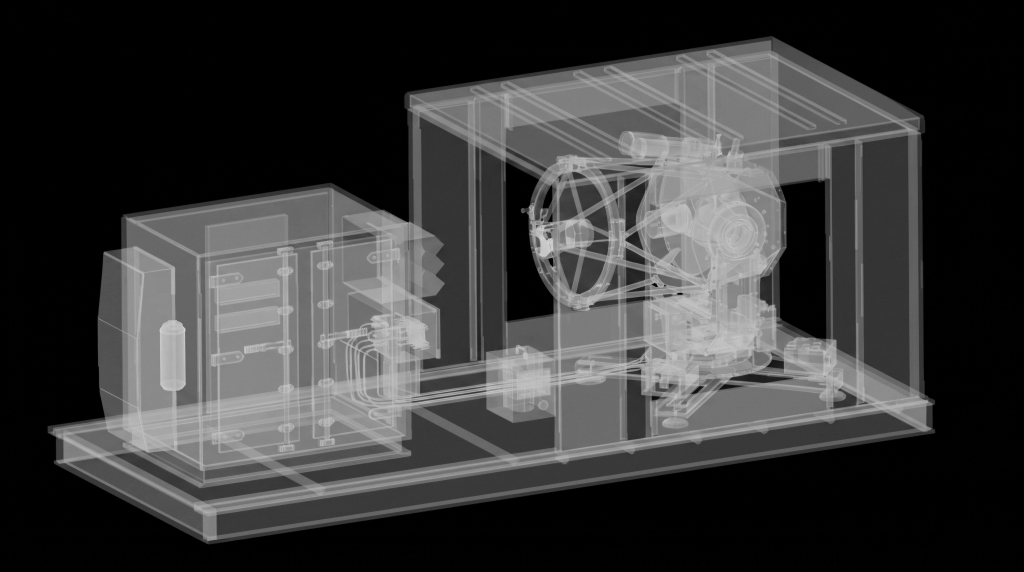
TILBA®-TOGS architecture
By bringing together these operationally proven technologies, TILBA®-TOGS provides military users with secure, high-capacity satellite communications that can be rapidly deployed on unprepared terrain and easily transported by truck, trailer, or military aircraft.
1. Strategic transport
Stored in a logistics hub, TILBA®-TOGS can be transported by cargo aircraft such as a C130 directly to the operational theater. Mounted on a transportable standard skid, it enables the rapid projection of a secure, low-detectability communication capability wherever it is needed.
2. Tactical transport
Loaded onto a NATO-standard truck or trailer, TILBA®-TOGS follows the pace of operations. Its transportability allows communication capabilities to be brought closer to deployed forces.
3. Deployment
Unloaded and placed directly on unprepared terrain, TILBA®-TOGS is deployed in few hours, minimizing setup time and maximizing operational availability.
4. Communication
TILBA®-TOGS establishes optical links with satellites in orbit. EO imagery, ISR data, mission updates, and command-and-control communications can be transferred at high speed while benefiting from the inherent advantages of optical communications: low probability of detection (LPD), low probability of interception (LPI), and immunity to RF jamming.
5. Pack-up & Repeat
TILBA®-TOGS can be packed up and loaded back onto a tactical truck, ready to move to the next deployment site. Once there, it can be rapidly redeployed and brought back into operation. The cycle can be repeated wherever the mission requires.

Modern military operations increasingly depend on the rapid exploitation of information. A large part of that information is now collected by sensors in space, including Earth observation satellites, ISR payloads, and other space-based sensing systems, but intelligence collected in space only creates operational value once it reaches analysts, decision-makers, and deployed forces.
As Earth observation satellites continue to improve their revisit rates and resolution, access to the ground segment is becoming a new bottleneck. OGSaaS approaches are emerging to address this challenge, helping shorten the time between image acquisition in orbit and delivery to end users. However, the real challenge is delivering that information to the right people quickly enough to influence operational decisions.
TILBA®-TOGS helps address this challenge. Beyond supporting the mobility of command posts and forward-deployed forces, it provides a secure gateway to space that can be established wherever command posts require. By bringing an optical downlink capability closer to the operational center, imagery, intelligence products, mission updates, and command-and-control information can be delivered rapidly from space to users on the ground. The result is a shorter path between collection and action. In operations where minutes can influence outcomes, reducing the sensor-to-decision timeline becomes a critical capability.

Future operations will demand communications that are simultaneously secure, high-capacity, and mobile. As forces become increasingly dispersed and dynamic, fixed infrastructure alone cannot address every operational scenario. TILBA®-TOGS was developed to bridge this gap. By combining transportability, rapid deployment, and optical communications, Cailabs and DataPath are enabling temporary, high-performance gateways to space wherever the mission requires, allowing optical communications to move at the pace of operations.