

Cailabs builds first transportable optical ground station ahead of US assembly with Gilat DataPath
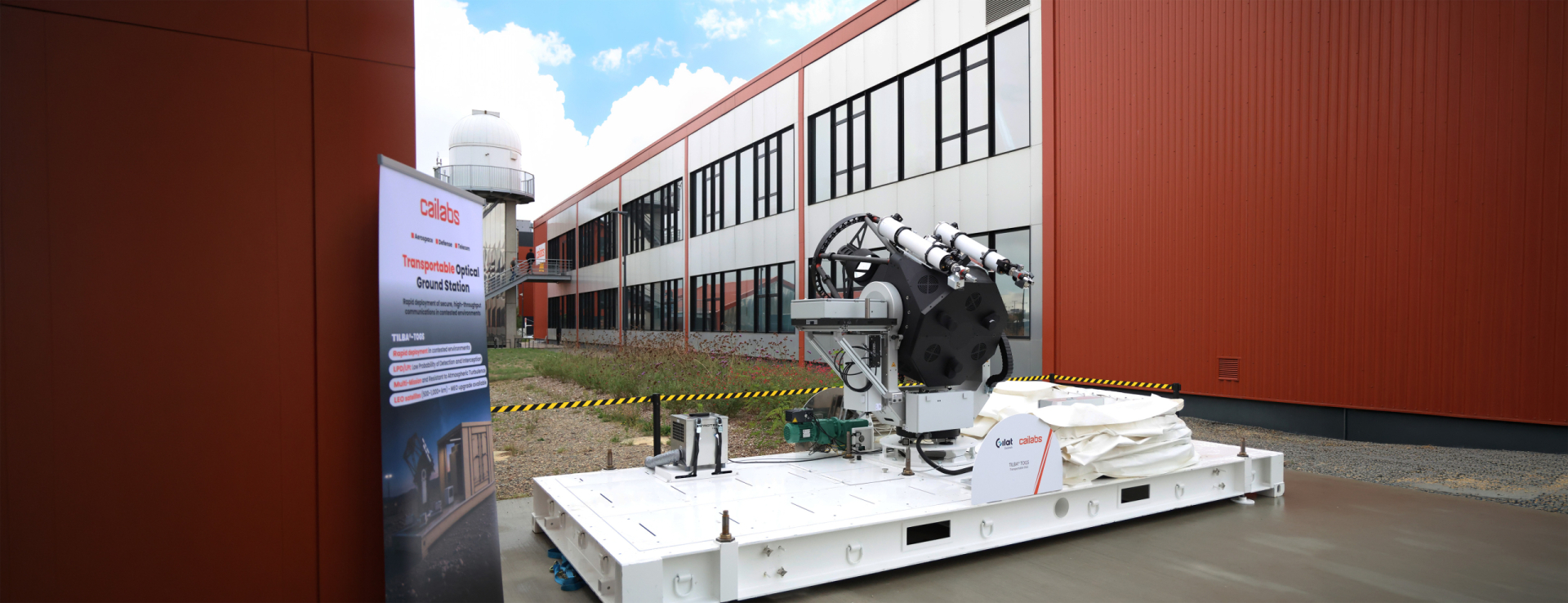
- Cailabs is building its first Transportable Optical Ground Station (TOGS) in Rennes, France.
- The first unit is currently being demonstrated in France.
- The companies are preparing for an initial production series of up to 12 units in 2027, with the potential for assembly in Gilat DataPath’s facilities in Duluth, Georgia.
- TOGS combines Cailabs’ proven 10 Gbps optical communications technology with Gilat DataPath’s ruggedised military skid platform, already deployed with the U.S. Department of War, and international defence ministries.
- The system will give military users secure, high-capacity satellite communications that can be deployed rapidly on unprepared ground and moved by truck, trailer or military aircraft.
Rennes, France – September 15, 2026 – Global deeptech company Cailabs is building the first Transportable Optical Ground Station (TOGS) at its facilities in Rennes, France, in partnership with US communications specialist Gilat DataPath, a wholly-owned subsidiary of Gilat Satellite Networks, Ltd. (NASDAQ: GILT, TASE: GILT)
The first unit is currently being demonstrated in France. Building on this initial system, Cailabs and Gilat DataPath are preparing for an initial production series of up to 12 units in 2027. The industrial set-up could include assembly at Gilat DataPath’s manufacturing facility in Duluth, Georgia.
Cailabs and Gilat DataPath have been working together since 2025 to develop a transportable optical ground station combining their respective optical communications and deployable infrastructure capabilities.
The TOGS takes technology that has been shown to work reliably in stationary optical ground stations and puts it onto a standard military skid. Cailabs provides the optical system, including its technology for overcoming atmospheric turbulence, while Gilat DataPath provides the ruggedised transport platform and access to U.S. production and support infrastructure.
Cailabs’ optical chain is already at Technology Readiness Level 9, supports bidirectional links at 10 Gbps and has been validated with several government and commercial satellites. Gilat DataPath’s DKET 3420 skid platform is also TRL 9 and has already been deployed with the U.S. Department of War, and international ministries of defence.
The result is an optical ground station, designed to establish bidirectional optical links with low earth orbit (LEO) satellite constellations and move large volumes of data between forward and rear command posts, built for use on unprepared ground.
In contested environments such as conflict zones, conventional radio links can be jammed, intercepted or constrained by crowded spectrum. Optical communications has a low probability of detection and interception and is immune to radio-frequency jamming.
Jean-François Morizur, CEO and Founder of Cailabs, said:
“The next step for optical communications is to take them out of fixed sites and put them where military users actually need them.
“Together with Gilat DataPath, we’re taking technology that has already worked with satellites and putting it on a proven military platform that can be moved and deployed quickly.
“The first system is now being built in Rennes and is expected to be demonstrated in France this September. Our next objective is to move to a first series of up to 12 units in 2027. Working with Gilat DataPath also gives us the option to assemble systems in the United States as demand develops.”
Nicole Robinson, President of Gilat DataPath, said:
“The demand for transportable communications capabilities has never been greater. Military forces need systems that can be rapidly deployed, relocated, and operated wherever missions take them. Gilat DataPath’s transportable infrastructure is already trusted by the U.S. Department of War and allied forces around the world, and this collaboration with Cailabs helps transform advanced optical communications from a fixed-site capability into a deployable operational asset that can be brought directly to the point of need.”
Optical ground stations have traditionally been deployed as fixed infrastructure. The TOGS extends these capabilities to a transportable platform designed to be deployed where operational users need connectivity. Based on a standard 20-foot ISO military skid and compliant with C-130 transport requirements, the system can be moved by road or military aircraft and rapidly deployed in the field. It is designed for automatic operation to support LEO missions, with an upgrade path to medium earth orbit (MEO), and complies with Space Development Agency (SDA) standards.
Gilat DataPath brings an established worldwide support network which includes 80 field service representatives, including 40 supporting military operations across the globe. The TOGS marks an important step in the evolution of optical communications from fixed infrastructure to deployable operational capability. By combining proven optical communications technology with a transportable military platform, Cailabs and Gilat DataPath aim to make high-capacity optical links available wherever operational users need them.